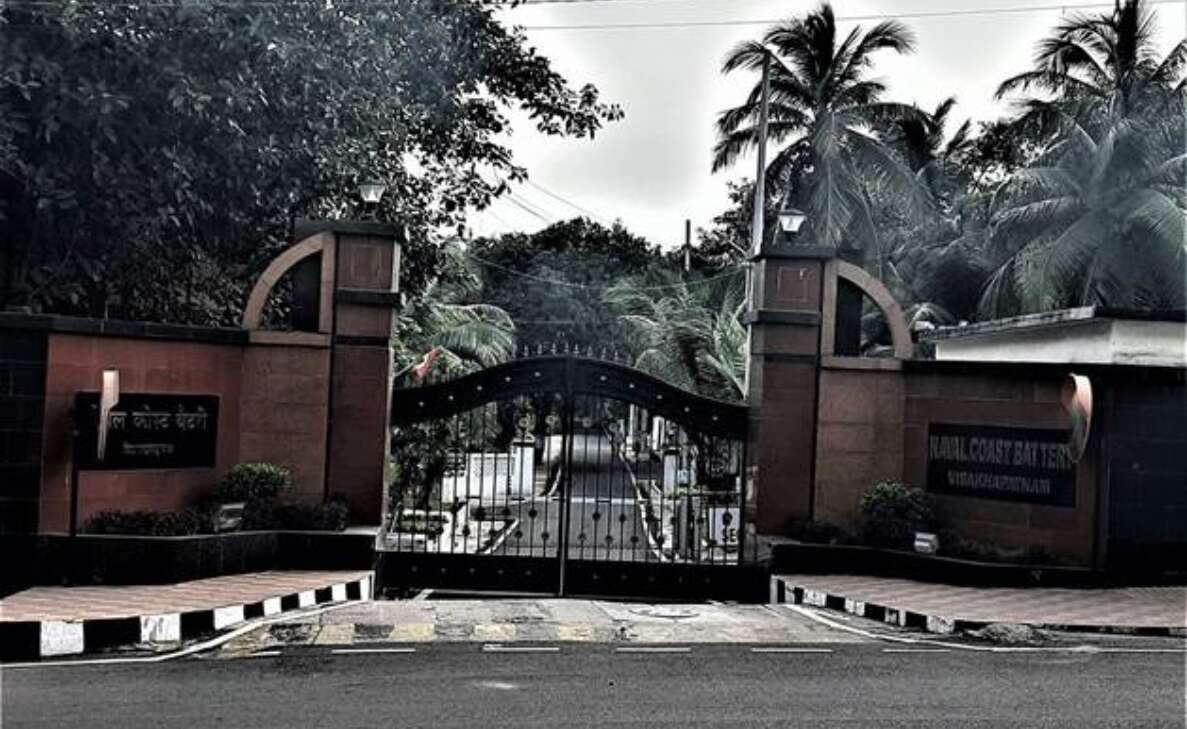
-It began with two 6-inch guns during World War II, with the Navy assuming responsibility in 1964; coastal defense mechanisms have modernized alongside changing times.
Visakhapatnam. Visakhapatnam, in Andhra Pradesh, is one of the country’s major maritime cities. While it is a significant commercial port, it also holds immense strategic importance for the Indian Navy. Driven by this maritime and strategic significance, a defense system was developed in Visakhapatnam years ago to protect the coastline and vital installations from potential military threats approaching from the sea. The Naval Coast Battery, Visakhapatnam (NCB-V), is a crucial part of this history.
To understand the Naval Coast Battery, it is essential to first recognize that the term does not refer to a standard battery or an electrical power system. It is a coastal military defense setup designed to monitor potential enemy ships or other military threats approaching from the sea and to take action against them if necessary. While maritime security technology has advanced significantly today—with modern coastal defense involving the coordination of radars, communication systems, maritime surveillance, warships, aircraft, helicopters, and various security agencies—the history of the Naval Coast Battery remains vital to understanding the evolution of India’s coastal defense infrastructure.
The history of the Coastal Battery in Visakhapatnam dates back to the era of World War II. Following the outbreak of the war in 1939, special measures were undertaken to secure India’s coastline and key ports. At that time, Visakhapatnam’s strategic importance was growing rapidly; the city was not only home to a port but was also a hub of significant maritime activity. Given the circumstances, the need was felt to deploy heavy artillery along the coast to guard against potential attacks from the sea.
According to historical records, the 5th Indian Heavy Battery was established here in 1940, and two 6-inch heavy guns were deployed. The objective was to possess the capability to engage potential enemy ships approaching from the sea at long range. In December 1941, the unit was redesignated as the 5th Indian Coast Battery. At that time, heavy artillery formed the backbone of coastal defense; the primary role of coastal artillery was to intercept approaching warships before they could reach the shore.
The geographical layout of the coastal area was taken into account when establishing this military setup in Visakhapatnam. Its open exposure to the sea facilitated the monitoring of maritime activity and provided the capability to deploy artillery when necessary. Fisherman settlements also existed in the area at the time; historical records indicate that, due to military requirements, some families were relocated, eventually leading to the development of settlements like Kotha Jalaripeta.
Visakhapatnam’s strategic importance grew further during World War II. History records an attack on the city by Japanese aircraft in 1942. During that period, Japanese forces were advancing rapidly across parts of South and Southeast Asia, creating a looming threat to India’s eastern coast. In this climate, the coastal defense system became increasingly vital for protecting key assets like the Visakhapatnam port and naval zone.
The primary function of the Coastal Battery at that time was to intercept enemy warships approaching from the sea. If the movement of an enemy ship appeared suspicious, coastal defense units played a role in identifying, monitoring, and—if necessary—taking action against it. However, the technology of that era was quite limited compared to today’s standards. Surveillance relied heavily on human observation, binoculars, communication networks, and other available means. Heavy artillery was considered the primary offensive capability for coastal defense.
Over time, India’s defense needs evolved, and the framework for coastal security developed alongside them. Following independence, the Indian Navy’s role expanded, and modern systems for securing maritime borders began to take shape. In 1964, the decision was made to entrust the responsibility of Coastal Batteries to the Indian Navy. Subsequently, the coastal defense unit at Visakhapatnam came to be known as the Naval Coast Battery, Visakhapatnam (NCB-V).
Once placed under the Navy, coastal security was integrated into a broader maritime defense system. Its importance grew as Visakhapatnam gradually emerged as one of the Indian Navy’s most vital hubs on the East Coast. Today, the Eastern Naval Command of the Indian Navy is headquartered here, playing a crucial role in safeguarding the nation’s eastern maritime region.
The role of the Naval Coast Battery cannot be viewed merely as operating artillery. The fundamental concept of coastal defense encompasses identifying and monitoring potential threats approaching from the sea, protecting critical coastal and naval installations, and countering threats using available defense resources when required. In the modern era, this task has become far more technologically advanced and multi-layered than in the past.
Today, maritime security involves radar-based surveillance, communication networks, maritime patrols, warships, naval aircraft, helicopters, the Coast Guard, and Marine Police…