-The government-run port boasts a rich legacy, vast capacity, and business worth thousands of crores; meanwhile, Adani’s Gangavaram Port is expanding its influence by leveraging deep waters, rapid operations, and modern technology.
Visakhapatnam. Having started nearly nine decades ago with limited exports of mineral ore, Visakhapatnam Port has established itself as a key maritime trade hub in the country. The port, where maritime operations commenced in 1933, has transformed into a modern maritime logistics facility handling millions of tonnes of cargo. In the 2024-25 fiscal year, the Visakhapatnam Port Authority handled a record 82.62 million tonnes (approximately 8.26 crore tonnes) of cargo, with management setting a target of 90 million tonnes (9 crore tonnes) for the next phase.
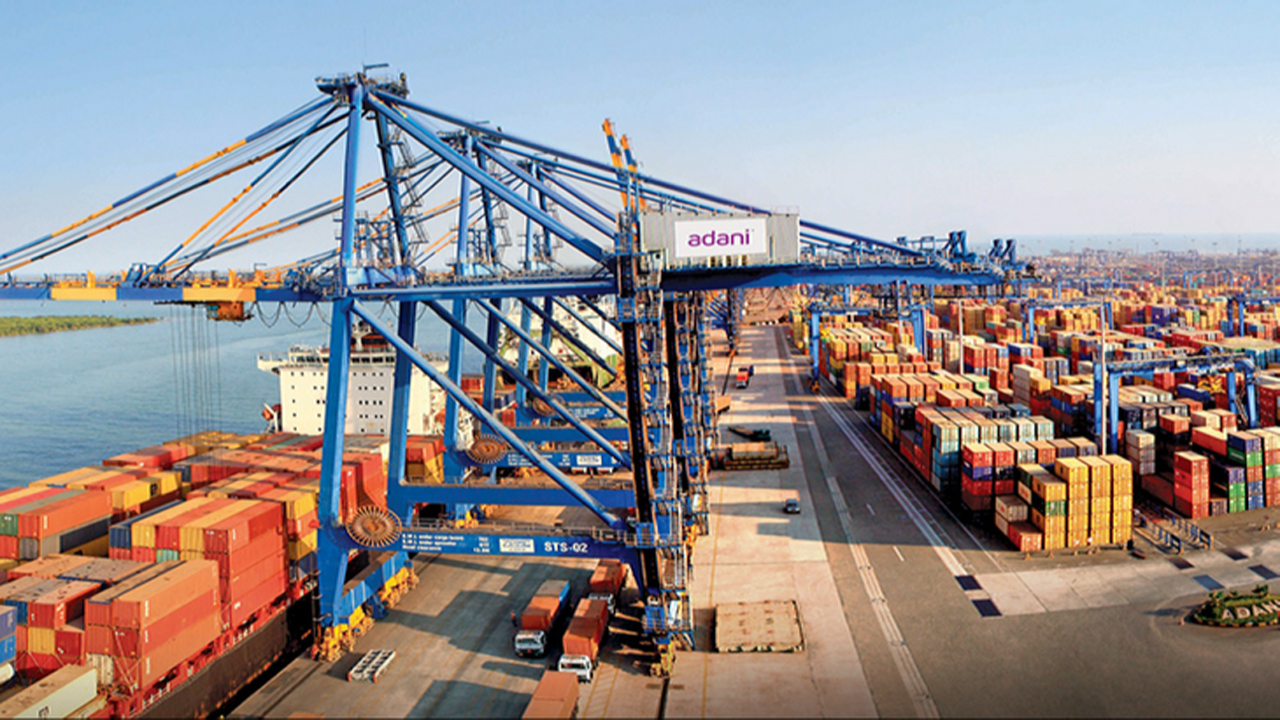
However, the story of Visakhapatnam’s maritime economy is no longer confined to the government port alone. Located about 15 kilometers south of the city, Gangavaram Port—now operated by the Adani Group—is steadily strengthening its position through modern technology, deep-water access, the capacity to handle large vessels, and rapid cargo evacuation. In 2022, Adani acquired the remaining 58.1 percent stake in Gangavaram Port, making it a wholly-owned subsidiary.
This has created an intriguing competitive landscape in Visakhapatnam’s maritime trade. On one side stands the decades-old government port, backed by established infrastructure, a massive cargo base, and strategic importance; on the other is the private-sector Gangavaram Port, which is forging ahead by leveraging strengths such as large-vessel handling, automation, quick turnaround times, and multimodal connectivity. The history of Visakhapatnam Port dates back to October 7, 1933, when modern port operations commenced with the arrival of the ship SS Jaladurga. Initially, the export of mineral ores was its primary business. Over time, as industrial development expanded, the movement of coal, iron ore, steel, petroleum products, fertilizers, containers, and other industrial goods through the port steadily increased.
Today, the port’s hinterland is not limited to Andhra Pradesh alone; its business network extends to Odisha, Chhattisgarh, Telangana, and other industrial regions across the country. Consequently, the activities of Visakhapatnam Port are directly linked to the industrial economy of Eastern and Central India.
The port’s geographical location is also a major strength. The natural formation of ‘Dolphin’s Nose’ helps shield the port from harsh marine conditions. Its capacity to handle large vessels and the development of berths for diverse cargo types have long established it as a vital maritime hub on the East Coast.
The port has also enhanced its capabilities in the container business. Modern container terminal facilities—such as extended quays, quay cranes, electric yard equipment, ground slots, rail sidings, and digital gates—have been developed. The rapid growth in container operations is evident from the continuous expansion of capacity to handle large-sized container vessels.
However, the key question amidst this scenario is: in which direction will the competition between the state-run Visakhapatnam Port and the privately-owned Gangavaram Port evolve in the coming years?
Adani’s Gangavaram Port adds significant weight to this question. According to the company, Gangavaram is an all-weather, deep-water, multipurpose port. It features nine berths, with depths reaching up to approximately 19.5 meters, and possesses the capability to handle super-capesize vessels. It possesses facilities for bulk, break-bulk, and container cargo, and is connected to the hinterlands of eight states via rail and road networks.
This is where the distinction between the two systems becomes apparent. The primary strengths of the state-owned Visakhapatnam Port lie in its long-standing maritime identity, diverse cargo handling capabilities, and extensive government-backed infrastructure. In contrast, Gangavaram’s strengths are evident in its deep-water access, capacity to handle large vessels, highly mechanized cargo handling, and rapid evacuation systems.
According to an Adani report, Gangavaram Port has a capacity of 64 million tonnes, and it recorded a throughput of 36.6 million tonnes in the 2025-26 fiscal year. The port also operates a container terminal and has recently set new records for the movement of large, deep-draft vessels and cargo operations.
Ultimately, the competition is not merely about the volume of cargo handled. The real contest hinges on the speed of berthing, the efficiency of loading and unloading operations, the swiftness of onward transport via rail and road, and the total logistics cost incurred by the customer.
This is precisely the area where private ports are driving rapid transformation. The Adani Group views its port network not merely as a system for loading and unloading cargo, but is actively pursuing a strategy to integrate ports, rail, road, warehousing, and logistics. For FY2025-26, the company has prioritized automation, digital gates, capacity expansion, and multimodal connectivity across its port network.
For Visakhapatnam, this competition presents both a challenge and an opportunity. It is a challenge because if ships experience faster turnaround times at one port compared to another—with the ability for larger vessels to dock easily and cargo to be cleared quickly—shipping companies and cargo owners naturally consider that option. It is an opportunity because competi…